Most people know context switching is bad for productivity. What they don't know is how bad, how often, and exactly what's causing it. For 12 weeks, we analyzed anonymous usage data from up to 6,400 Rize users per week, tracked between January and March 2026. Rize is an automatic time tracker trusted by 350,000+ professionals that logs every app you use and every window you switch to, passively and in the background. The result: the average user switched contexts 559 times a day, or roughly once every 35 seconds. The data was jarring.
Quick Answer
The hidden cost of context switching: Real Rize data shows the average user switches apps 559 times per day, about one switch every 35 seconds, and Slack is the single biggest trigger. Each switch feels small, but UC Irvine research shows it takes 23 minutes to refocus after an interruption. Start a free 7-day trial to see your own switching patterns.
How often does the average person switch context?
The average Rize user switched apps or contexts 559 times per day. Against an average tracked workday of 5.4 hours, that works out to roughly 103 switches per hour, or one context switch approximately every 35 seconds.
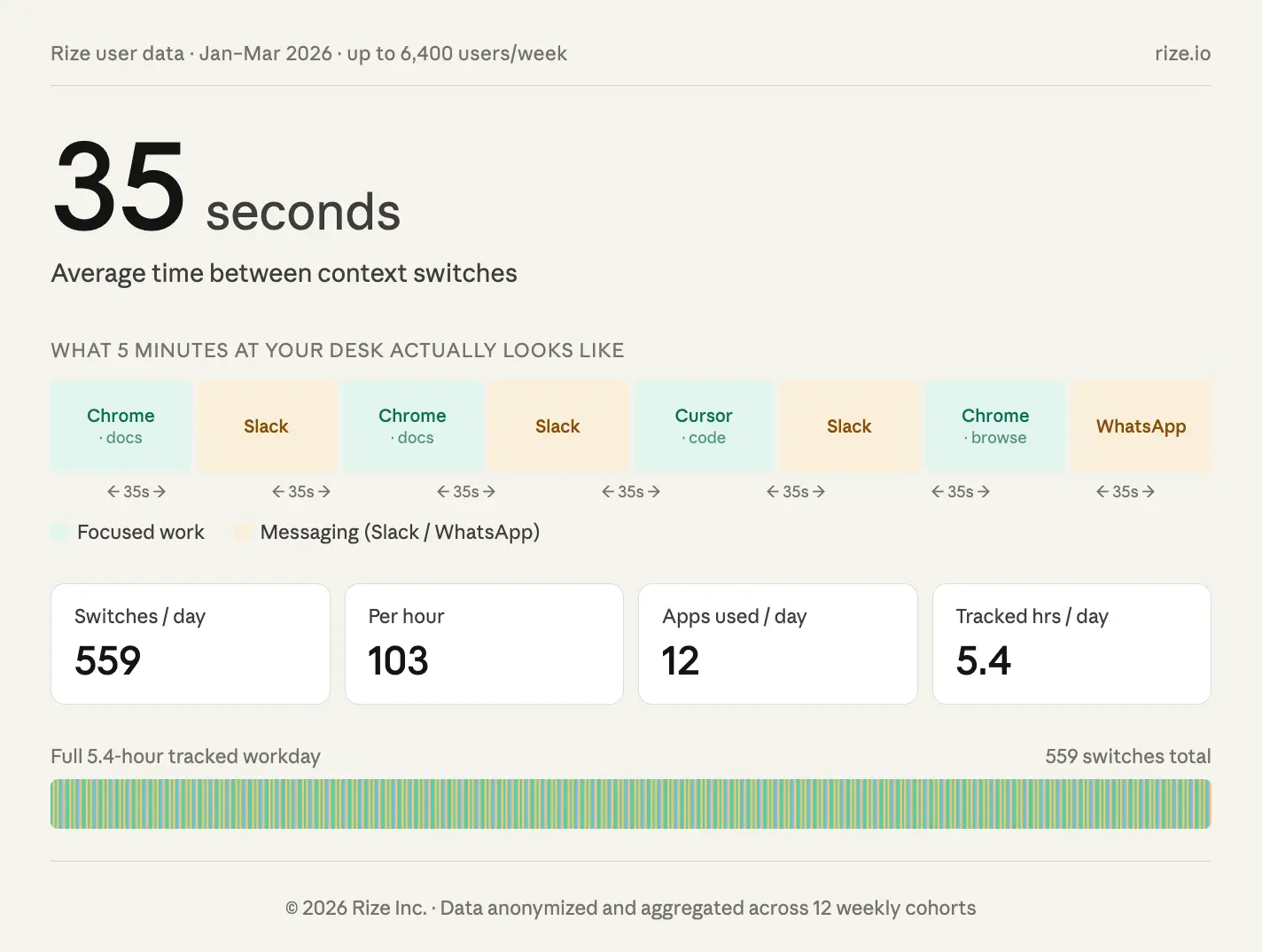
Think about what that means in practice. You open a document, write half a sentence, jump to Slack to reply to a message, flip to your browser, circle back to email, then return to the document. Except now you've lost the exact thought you were building. Multiply that loop by 559, and you have a fairly accurate picture of how the average knowledge worker's day actually flows.
This isn't an anomaly of one bad week. It held steady across all 12 weeks. Weekly averages ranged between 496 and 599 switches per day, and the average rarely moved more than 15% in either direction. Fragmentation is baked into how most people work, not an exception to it.
Which app causes the most context switching?
Slack is the single biggest trigger of context switching in the dataset. The most common app-to-app transition was Slack to Google Chrome (browsing), with 101,173 recorded transitions over 12 weeks. The reverse, Chrome back to Slack, added another 87,735, for nearly 189,000 round trips between Slack and a browser, for browsing alone.
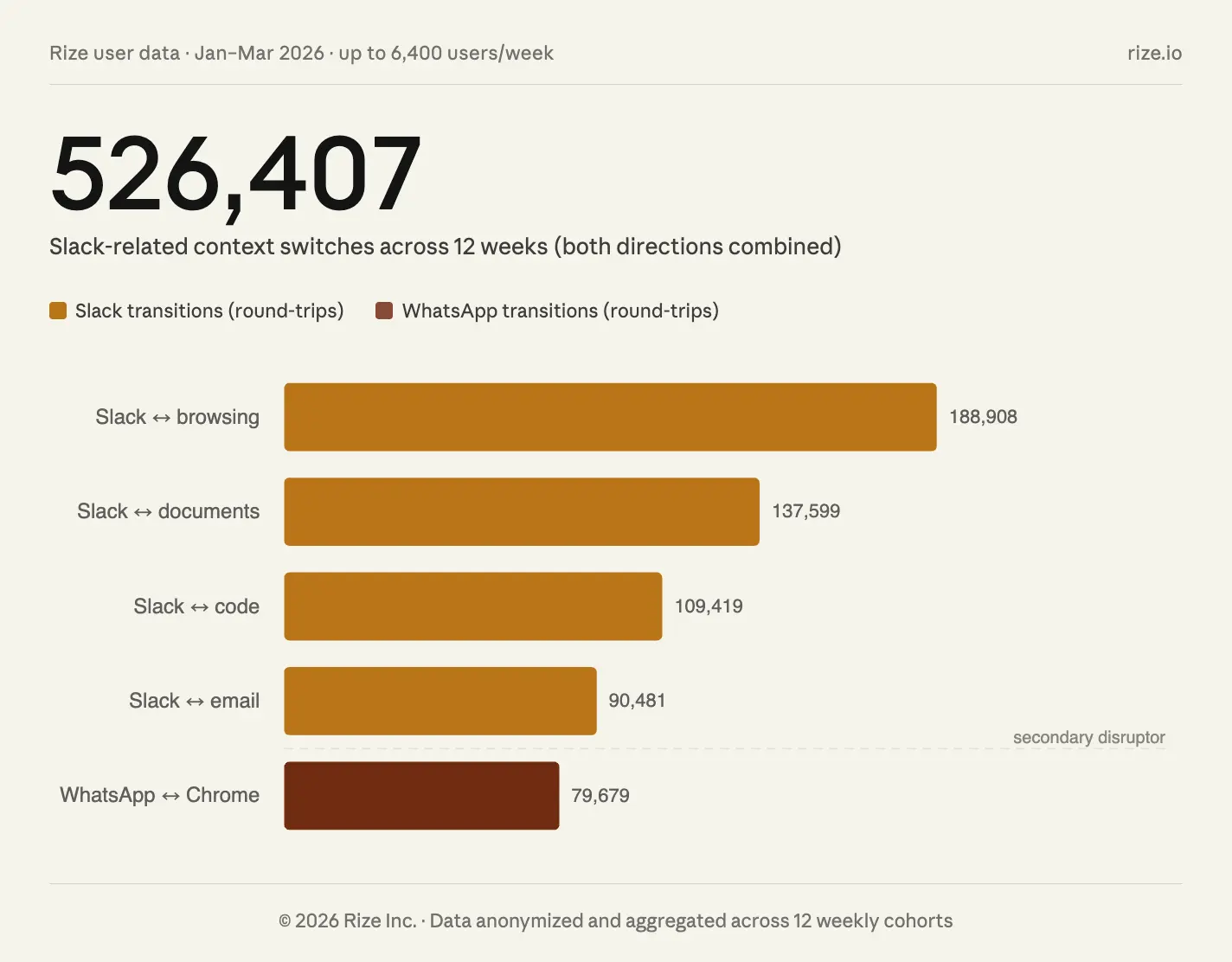
Slack also interrupted document work (Chrome documenting to Slack and back: 137,599 combined transitions), technical work (Chrome and Cursor in code mode to Slack and back: 109,419 combined transitions), and email (Slack to Chrome email and back: 90,481 combined transitions). Slack is involved in the majority of the most disruptive context switches a professional makes, across every type of focused work, every single week.
WhatsApp is worth noting too. The WhatsApp-to-Chrome pair logged over 79,000 combined transitions in the 12-week window. For users juggling both Slack and WhatsApp for work communication, which the data shows is common, the switching problem compounds quickly.
Why does the cost of context switching stay hidden?
The individual cost of each context switch feels invisible in the moment, which is exactly why the total stays hidden. Opening Slack for 45 seconds doesn't feel like a significant interruption. Each switch is small. The aggregate is where the damage lives.
With 559 switches happening across a 5.4-hour workday, your brain is shifting gears roughly every 35 seconds. According to research by Gloria Mark at UC Irvine, it takes an average of 23 minutes and 15 seconds to return to the original task after an interruption. When that interruption is Slack, which pulls you into a completely different mental context that is social, reactive, and low-depth, the ramp back to writing a spec or reviewing code is steeper than most people recognize.
The penalty is well documented. The American Psychological Association reports that even brief mental blocks from switching between tasks can cost as much as 40% of someone's productive time. Sophie Leroy's research on "attention residue" explains why: when you switch tasks, part of your attention stays stuck on the previous one, so you arrive at the next task already operating at reduced capacity.
What does context switching cost developers?
Developers pay one of the steepest costs. In this dataset, around 900 Cursor users logging 35,488 total tracked hours across 12 weeks bounced between Cursor and Slack at a combined rate of roughly 68,000 transitions.
Engineers doing focused technical work are losing their train of thought to a messaging app, constantly, on a measurable scale. Code is exactly the kind of work where attention residue hurts most: holding a mental model of a system in your head, then dropping it to read a Slack thread, then trying to reload it. This is data from people who actively chose to track their time, which skews toward the more productivity-conscious end of the spectrum. The average worker is likely switching even more.
Why don't most time trackers show context switching?
Most time trackers don't surface context switching at all. They show you time blocks: "3 hours on Project X, 1 hour on email." That's useful for billing. It's nearly useless for understanding why you can never seem to finish a thought before something interrupts it.
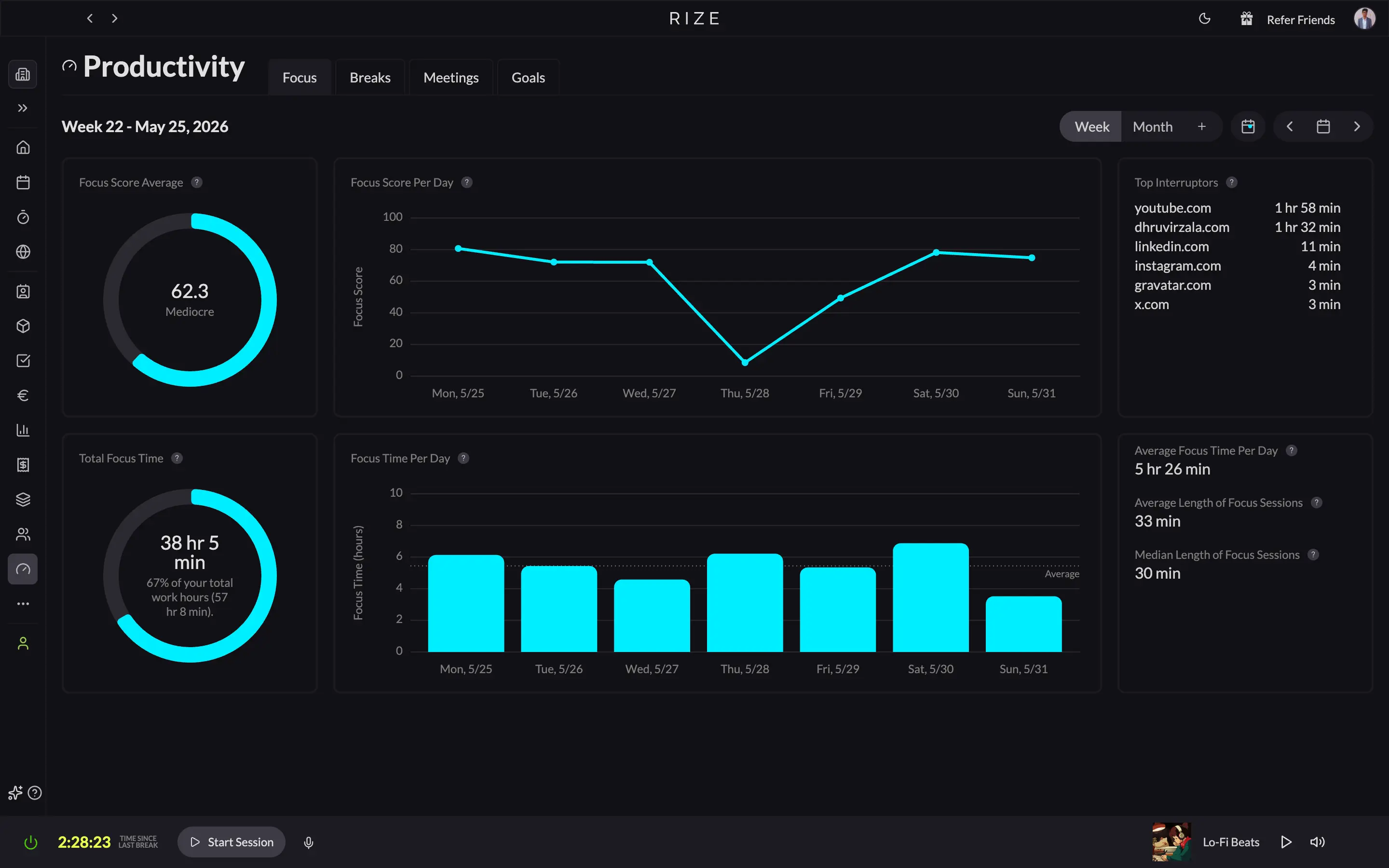
Rize tracks at the app-activity level automatically, in the background, with no manual effort from you. It runs quietly while you work, logging every app switch and every minute of active time, then surfaces patterns you couldn't see before. You might suspect Slack is distracting you. Rize tells you exactly how many times it interrupted your focused work this week, which apps triggered those interruptions, and what time of day your fragmentation is worst.
That specificity is what turns a vague intention to "be more focused" into behavior change you can act on. We've written about how to limit context switching before. The data here is the part you can't see about yourself without a tool measuring it in the background.
How do you actually fix context switching?
Context switching isn't a willpower issue. It's a measurement problem, and you cannot fix what you cannot see. The starting point is making the switching visible: how often it happens, which apps trigger it, and when your attention breaks down.
The data behind this article comes from people who were already trying to understand their time better. They installed Rize on their Mac or Windows machine and let it run. What it gave them back was not a timesheet or a billing report. It was a mirror: 559 app switches per day, Slack sitting at the center of every disruption, and a fragmented workday that no amount of good intentions was going to fix on its own.
That is what Rize is built for. It tracks every app, every window, and every context switch automatically, then surfaces the patterns in a clean productivity dashboard you can act on. For managers, the same visibility extends across a whole team, showing where focus time is leaking before it shows up as missed deadlines. The 12-week dataset makes one thing clear: visibility is the starting point for everything else.
See how often you actually switch. Rize tracks context switching automatically. Start a free 7-day trial.