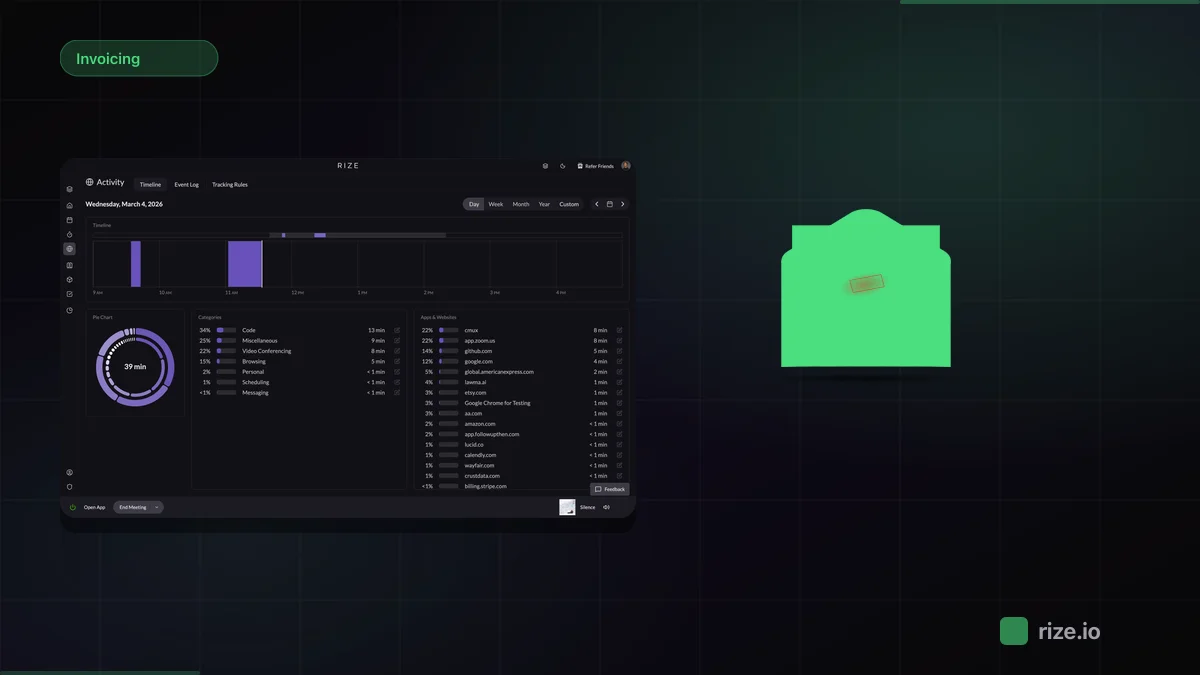
Flat-fee accounting firms measure client profitability by subtracting fully loaded delivery cost from the fee and dividing by the fee. Delivery cost is actual hours on the client multiplied by each person's loaded cost rate. The fee tells you nothing about cost, so the measurement is only as good as the hours behind it. This guide covers the formula, how to build cost rates, a worked example, and how to collect hours without punch clocks.
Quick Answer
Client margin = (fee - delivery cost) / fee. Delivery cost = actual hours per person on the client x that person's loaded cost rate. Measure it monthly per client, rank clients by margin, and reprice or rescope the bottom of the list at renewal. Automatic time capture, such as Rize for accounting firms, supplies the hours without asking staff to run timers.
How Do Flat-Fee Accounting Firms Measure Client Profitability?
Flat-fee firms measure client profitability with one formula: (fee - fully loaded delivery cost) / fee, calculated per client per month.
The formula needs three inputs. The fee is known from the engagement letter. The hours are the actual time each person spent on the client's work, split by engagement. The cost rate is what an hour of each person costs the firm. Hourly firms get a margin signal for free because the invoice is the measurement. Flat-fee and value-priced firms broke that link on purpose, and many lost the measurement with it.
The usual failure looks like this: an engagement quoted at 12 hours takes 24, and nobody notices until a partner does the math at renewal, if anyone does it at all.
How Do You Calculate a Loaded Cost Rate?
A loaded cost rate is (salary + benefits + employer payroll taxes + allocated overhead) / annual available hours for each staff member.
Employer payroll taxes are not optional extras. Per the IRS, employers pay 6.2% Social Security and 1.45% Medicare on wages, and the IRS FUTA guidance adds federal unemployment tax on the first $7,000 of each employee's wages. Benefits sit on top of that; the BLS Employer Costs for Employee Compensation release breaks compensation into wages and benefits if you need a reference point for your own mix.
Use available hours, not 2,080. Subtract holidays, PTO, CPE, and the internal time every firm carries. Give each person their own rate. Offshore and remote staff often carry very different rates from onshore seniors, and the margin story lives in who did the work.
Worked Example: Two Clients on the Same Fee
Two clients paying the same $2,000 monthly fee can have very different margins once hours and staff mix are priced in.
| Input | Client A | Client B |
|---|---|---|
| Monthly fee | $2,000 | $2,000 |
| Staff accountant hours ($45/hr loaded) | 10 ($450) | 14 ($630) |
| Manager hours ($85/hr loaded) | 2 ($170) | 6 ($510) |
| Partner hours ($150/hr loaded) | 1 ($150) | 4 ($600) |
| Delivery cost | $770 | $1,740 |
| Client margin | 61.5% | 13.0% |
The rates are illustrative; plug in your own. Client B is not unprofitable because of the fee. It is unprofitable because of partner review time and advisory questions that never appeared in the original scope. Without hours split by person, both clients look identical.
Why Do Manual Timesheets Hide Unprofitable Clients?
Manual timesheets hide unprofitable clients because the hours that erode margin are short, unplanned, and the least likely to be logged.
Most firms that collect time data get it from Clockify, QuickBooks Time, or legacy TSheets, which staff treat as payroll chores. The extra bookkeeping cleanup, the "quick tax question," and the senior review nobody scheduled rarely get entered. Accounting-firm buyers tell us the same thing on calls: "$5 a seat for Clockify, and it manually sucks." The report understates cost, the fixed fee looks fine, and the firm reprices a year late.
Context switching makes recall worse. Research by Gloria Mark at UC Irvine found it takes an average of 23 minutes to return to a task after an interruption, and accountants juggling dozens of clients switch constantly during busy season.
How Should a Firm Set Up Client Profitability Tracking?
Set up client profitability tracking in three steps: capture hours automatically, keep the existing billing system, and review margin by client every month.
1. Capture hours without asking for them. Asking fixed-fee staff to run punch clocks fails culturally and mechanically. Rize records work sessions in the background on Mac and Windows and assigns them to clients and projects, and staff review and approve the entries instead of typing them.
2. Keep your billing system. Firms refuse to duplicate systems, and they should not have to. Rize exports approved hours by CSV and connects to QuickBooks Online through Zapier, so invoicing stays where it is and the profitability view sits on top.
3. Review margin by client monthly and reprice quarterly. Rank clients by margin each month. Run a quarterly pricing review against actual cost per client, the same cadence as the fee increases most firms already do annually, now with evidence. The fixed-fee client profitability check walks through the review.
What Makes Flat-Fee Clients Unprofitable?
Flat-fee clients become unprofitable through scope drift, senior staff doing junior work, and seasonal workload spikes priced as average months.
Scope drift on tax clients. The 1040 turns into advisory calls all year. Hours by service line show whether the fee covers the relationship or only the return.
Senior time on junior work. Partner cleanup on staff-prepared work is the expensive kind of hour. Cost-rate margin catches what an hours-only view misses, as Client B shows above.
Seasonal averaging. A client profitable across the year can be deeply unprofitable in March. A fixed monthly fee hides the spike; monthly cost reporting exposes it.
Gut feel outrun by growth. A partner can track which clients are profitable when the firm is small. As the client list grows, that intuition stops matching the numbers, and the ranked margin list replaces it.
The firm's pricing is only as good as its cost data. If the profitability picture comes from a punch clock, it is wrong where it matters most. See how Rize works for accounting firms, compare Rize to QuickBooks Time for fixed-fee work, or book a demo.